
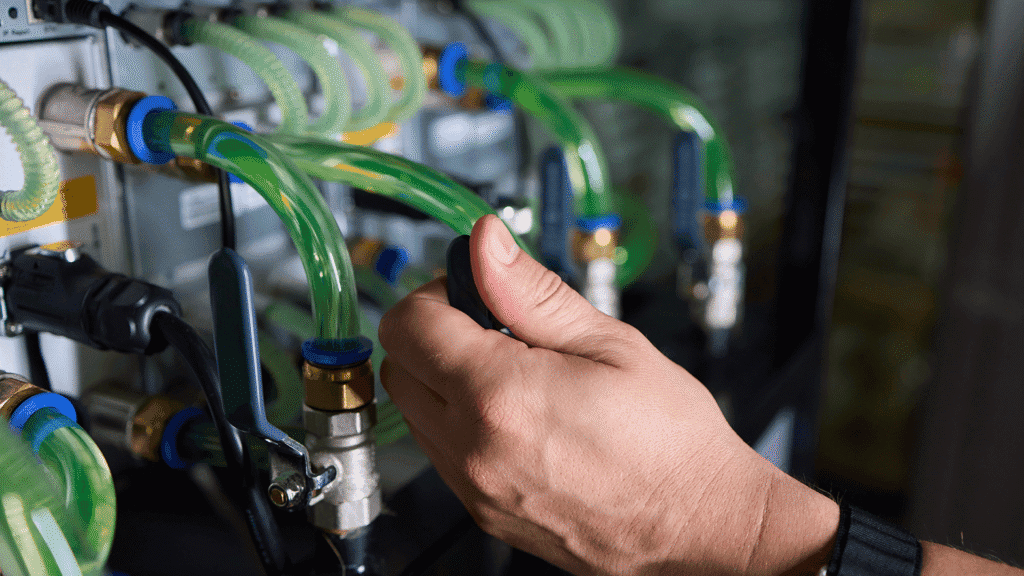
Understanding Liquid Cooling for Data Centers
As data demands grow with advancements like AI and cloud computing, traditional air-based cooling is increasingly challenged. According to Vertiv’s Data Center Trends 2025 report, rack densities are forecasted to spike to 500-1000kW in AI facilities. This escalation necessitates robust cooling systems to prevent equipment overheating, which could lead to costly and unexpected downtime.
The Functionality of Air and Liquid Cooling
Every data center must manage heat dissipation to safeguard its equipment. Air and liquid cooling both achieve this but through different methods. Air cooling utilizes air to capture and displace heat from IT systems, ideal for less dense setups. In contrast, liquid cooling uses water or specialized fluids to absorb and transfer heat efficiently, suiting high-density environments. Solutions like Liebert PDX Compact DX or Liebert® CW Chilled Water System cater to varying densities.
One prominent distinction between the two is the medium used for heat removal. Liquid cooling, by circulating coolant directly to hardware components, offers three main approaches:
- Direct-to-chip cooling: Coolant is directly applied to server chips, e.g., Vertiv™ CoolChip CDU.
- Rear door heat exchangers: These are mounted on the rear of server racks to manage the expelled heat, e.g., Liebert® DCD Rack Door.
- Immersion cooling: This submerges the complete server in a nonconductive liquid.
Evaluating Your Cooling Solution Needs
Choosing the optimal cooling solution is critically linked to your data center’s rack density. Facilities with low-density racks under 20kW might find air cooling sufficient. On the other hand, for racks exceeding 20kW, liquid cooling is generally essential. At 30kW or more, it becomes imperative due to increased heat production. The limitations of air cooling make liquid cooling a necessity for these high-powered servers. A hybrid model integrating both methods can efficiently address excessive heat concerns.
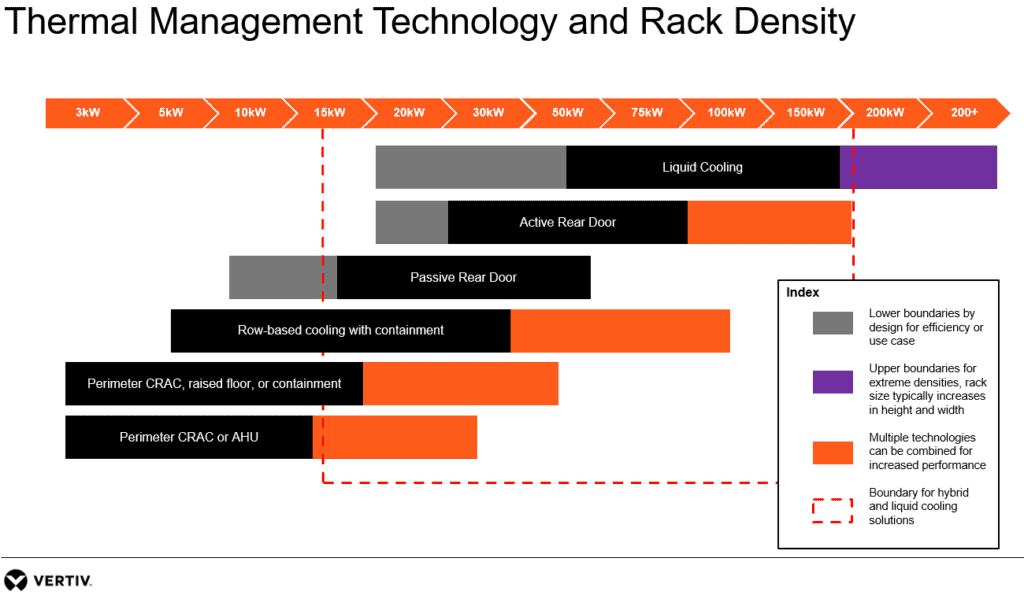
As AI and other technologies drive higher server densities, adopting hybrid approaches in cooling becomes vital. Innovations like the Vertiv™ CoolChip CDU exemplify this, efficiently combining liquid and air cooling to maintain optimal temperatures, reduce energy consumption, and support a flexible infrastructure.
FAQs About Liquid Cooling
- What is liquid cooling? Liquid cooling uses fluids to absorb and transfer heat away from electronic equipment, providing efficient thermal management for high-density setups.
- How does liquid cooling differ from air cooling? Unlike air cooling, which uses air as the medium, liquid cooling employs water or special liquids to more effectively manage heat.
- When should I consider liquid cooling for my data center? If your rack density exceeds 20kW, liquid cooling should be considered; it’s essential for densities of 30kW or more.
- Can liquid cooling be combined with air cooling? Yes, hybrid systems can leverage both methods, using liquid cooling for high-density areas and air for ambient room control.
- Why is liquid cooling becoming more prevalent? As technologies like AI demand greater density from data centers, liquid cooling’s efficiency in heat management makes it a preferred solution.
Stay Informed on Data Center Advances
To maintain an optimal environment for your critical infrastructure, staying informed about the latest in data center cooling technology is crucial. Subscribe to our newsletter for insights and updates tailored to enhance your facility’s operations. For personalized assistance, call us at 412.787.1313.